Showing posts with label ONU. Show all posts
Showing posts with label ONU. Show all posts
20260918
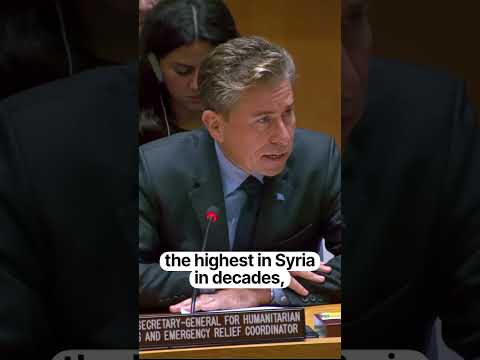
Historic return of millions of Syrian #refugees #Syria
Briefing by Tom Fletcher, Under-Secretary-General for Humanitarian Affairs and Emergency Relief Coordinator, Office for the Coordination of Humanitarian Affairs (OCHA), on the situation in the Middle East (Syria).
For more information or to watch video on YouTube, click here!

Countering Hate Speech: We must raise our collective voice - UN Chief's Briefing | United Nations
Secretary-General Antonio Guterres reiterated, “we must raise our collective voice and reject hatred. And we must redouble our efforts to tackle hate speech, online and offline.” Guterres spoke at the Global Conference on Promoting Interreligious and Intercultural Dialogue and Tolerance in Countering Hate Speech. The Conference was jointly organized by the Kingdom of Morocco, the United Nations Office on Genocide Prevention and the Responsibility to Protect, and the United Nations Alliance of Civilizations (UNAOC). The Secretary-General highlighted that the effort to counter hate speech must be truly inclusive, grounded in respect and equity; shaped by women, men, and youth; and welcoming of religious, traditional, and community leaders, Indigenous Peoples, and minority groups. He also emphasized, “reining in hate speech does not mean extinguishing freedom of expression. But freedom of expression must never be an excuse for causing or compounding harm.” Guterres underscored, “we cannot conquer hate speech on our own. Governments, regional and multilateral organizations, the private sector, and civil society — including faith communities, academia, and the media — have a shared responsibility to help build peaceful, just, and inclusive societies.” “We all have a role to play,” the UN chief said, “no bystanders.” Guterres continued, “that is why I come to you today with an urgent message: We must work together to foster mutual understanding. To end the tragic cycles of fear, hatred, and violence. And to build the cohesive and stable societies envisioned in our Charter.” The Secretary-General conclude, “let us rise to this challenge. And let us deliver on our shared promise to current and future generations.”
For more information or to watch video on YouTube, click here!
Syria: Syrians return home in historic wave of return - Briefing | United Nations
Briefing by Tom Fletcher, Under-Secretary-General for Humanitarian Affairs and Emergency Relief Coordinator, Office for the Coordination of Humanitarian Affairs (OCHA), on the situation in the Middle East (Syria). In his address to the Council, humanitarian Chief Tom Fletcher said, “since December 2024, more than 2 million internally displaced Syrians, 1.8 million refugees have gone home voluntarily. This is a historic wave of return – the highest in Syria in two decades – is a profound sign of hope.” Fletcher said, “through 300 partners, we’ve reached over 2.5 million people monthly this year with humanitarian support, reopening key routes into Al-Hassakeh and flights to Deir ez Zour in August. However, four major obstacles threaten this progress: continued displacement, localized insecurity, regional escalation, and landmines.” He said, “as winter approaches and the regional situation remains unstable, funding will be vital as a bulwark against losing those advances Syria has fought so hard to achieve. If we fail to invest today, the costs will be higher tomorrow – in renewed displacement, deteriorating services and lost opportunities to consolidate stability and transition towards reconstruction and development in Syria.”
For more information or to watch video on YouTube, click here!
20260917
Afghanistan: Key risks to country's stability are accumulating - UNAMA Briefing | United Nations
UN Deputy Special Representative for Afghanistan Georgette Gagnon said that key risks to the country’s stability are accumulating and mainly stem from the de facto authorities’ own policies. The Security Council held an open briefing on the work of the 1737 Sanctions Committee concerning Iran. Addressing the Council today (16 Sep) Gagnon said, “Last month, the de facto authorities marked the fifth year of their return to power. They projected confidence, highlighting nationwide control, improved security, infrastructure development, and economic stabilization efforts as evidence of their success. They also launched an initiative to improve institutional openness and accountability.” She highlighted, “These developments are encouraging. They are occurring, however, in a context of no progress on issues that are of profound concern to the Afghan people and the international community: the severe restrictions on women and girls, exclusionary governance, a human rights crisis, and the continued presence of terrorist groups that threaten Afghanistan, the region, and international peace and security.” She said, “Food insecurity and malnutrition present a serious concern. UNICEF reports that some 3.7 million children are suffering from deficient malnutrition, including around one million children experiencing severe acute malnutrition.” She also said, “Afghanistan continues to experience an extreme demographic and socioeconomic shock. This year alone, nearly 1.2 million Afghans have returned from Pakistan and Iran, with total returns reaching reached 6.5 million since 2023.Without sustained support for returnees and host communities, competition over scarce resources risks fueling grievances, increasing displacement, and promoting instability.” She continued, “By denying women access to education, professions, and public life, the de facto authorities are not safeguarding Afghanistan’s future.” She added, “Relations between Afghanistan and Pakistan remain another matter of serious concern. The effects of sporadic hostilities and the almost year-long border closure are taking an increasing toll on civilians, communities and businesses. UNAMA continues to encourage de-escalation and dialogue to resolve differences, including on the presence of terrorist groups in Afghanistan.”
For more information or to watch video on YouTube, click here!
20260916
Mass displacement crisis escalates in #Yemen
Assistant Secretary-General Khaled Khiari at the UN Security Council.
For more information or to watch video on YouTube, click here!
UN Chief ahead of the 81st session of the UN General Assembly - Press Conference | United Nations
Press Conference: UN Secretary-General António Guterres ahead of the 81st session of the UN General Assembly.
For more information or to watch video on YouTube, click here!
Yemen: Fighting has Intensified as Houthis advance in the Red Sea - Briefing | United Nations
“Fighting has intensified along Yemen's west coast, as the Houthis continued their advance towards the Bab al Mandab Strait, reportedly capturing several islands in the southern Red Sea,” Assistant Secretary-General Khaled Khiari told the Security Council. Briefing the Council members today (15 Sep) in New York, Khiari said the Government of Yemen had reportedly launched a counteroffensive after the Houthi advances of the past week, with clashes across several frontlines, including in Marib, Al-Jawf and Taiz. He noted that unconfirmed estimates indicated hundreds of combatant casualties in recent days. The Assistant Secretary-General reported that approximately 2,300 people fleeing the fighting had arrived in the Obock region of northern Djibouti as of 14 September. UN teams are working with the Djiboutian government to respond, and further arrivals are expected. Khiari noted that on 14 September, the Houthis claimed to have targeted the King Khaled Airbase in Khamis Mushait, in southern Saudi Arabia, with ballistic missiles and drones. He warned, “The longer the Strait remains choked, the higher the cost globally. Further escalation risks grave consequences for international peace and security, global energy markets, food security and economies of countries that are beyond region, particularly the most vulnerable.”
For more information or to watch video on YouTube, click here!
20260915
Sudan: 'World’s Largest Hunger & Displacement Crisis' - WFP Press Conference | United Nations
“Sudan is still the world's largest hunger and displacement crisis,” Carl Skau, Acting Executive Director of the World Food Programme (WFP), said. Today (14 Sep), following his mission to Sudan, Skau addressed the press and said that in the country “20 million people in acute hunger, 14 million people displaced, some 5 million of those acutely hunger in emergency level (IPC4), and you know still 200,000 in IPC5 levels of starvation.” He added, “Given that Sudan does, in my view, not get by far the attention it deserves. You know, humanitarians are attacked. We had a hit two weeks ago only on one of our convoys, trying to get to dealing in in the Kordofan, access is difficult, as I explained, partly due to security, partly due to not getting the clearances necessary. But it's also possible to work there. WFP reaches, you know, between 4 and 5 million people every month. 2 million or 2.5 million of those are in the hardest to reach areas, so it is possible to make a difference.” He highlighted, “Now, what is really our main challenge is funding. Our operations are completely underfunded, and there is a risk that we will have to scale back quite significantly in the next few weeks unless more funding is being provided.” He also said, “Darfur hasn't been this dry since 1984, and right now it's a rainy season, and so you know everyone is frightened that this will have a serious hit on agriculture and the agriculture outcome, and then of course also for livestock further down the road. And like some told me, you know, we rely on that agriculture, and we rely on the WFP food. And if you know the agriculture is now hit by the drought, and WFP's food is hit by funding cuts, how will we survive?’ And I think that is, you know, really the concern in Darfur for the next few months.” Talking about El Obeid, he stressed, “Our challenge there is also funding. So, we are providing less and less, but we're also having to cut off assistance to those who arrived three years ago. So, we are prioritizing those who are newly arrived, but of course to the detriment of those who have been there longer - which, frankly, people who have nothing to turn to either. It's not possible for them to get any jobs. They have been through terrible atrocities. They cannot return home. So, it's a very tense and difficult place where we now have to so tightly prioritize.” He concluded, “What we see playing out in Sudan is really, you know, what we also see at the global level, and it's all hitting at once. So, it's the conflict that is, you know, driving displacement, disrupting markets and trade; it is the maritime disruptions in Bab El Mandeb and Hormuz that is really hitting Sudan as well, with its ports on the Red Sea; and thirdly, it's El Niño and the climate shocks with the drought we now see in the Darfur, and all this is coming together, really putting pressure on the already suffering people in in Sudan.”
For more information or to watch video on YouTube, click here!
Memory of King Harald V of Norway: 'No Child is Forced to Flee Home Because of War' - United Nations
Remarks by Courtenay Rattray, Chef de Cabinet, on behalf of António Guterres, Secretary-General of the United Nations, on the Memory of his Majesty King Harald V of Norway.
For more information or to watch video on YouTube, click here!
20260914
#UNGA81 - 81st General Assembly session
Next week, world leaders will gather at UNHQ in New York for the 81st General Assembly session. Together, they will seek solutions to some of the most pressing issues facing humanity. Learn about the high-level events set to take place: https://www.un.org/en/high-level-week-2026
For more information or to watch video on YouTube, click here!
BRICS Summit: All must work to strengthen a multilateral system - UN Chief | United Nations
In his remarks to the 18th BRICS Summit 2026, in New Delhi, India, Secretary-General António Guterres said, “as we move irreversibly to a multipolar world, all countries must work to strengthen and safeguard a multilateral system that delivers for all with the United Nations at its centre.” During the third day of the Summit, Guterres met with the Prime Minister of India, Narendra Modi. Addressing the plenary, he called for Security Council and Bretton Woods institutions reform. The Secretary-General outlined four pillars for building inclusive global growth, financing, technology, climate justice, and peace. He said, “from Gaza to the broader crisis in the Middle East, to Ukraine, Sudan and beyond, our world needs peace,” and stressed that “States must respect their obligations under the UN Charter and international law, including the principles of sovereign equality, respect for territorial integrity and political independence of States, international navigational rights and freedoms, peaceful settlement of disputes, international humanitarian law and international human rights law.” To conclude, he said, “as we move irreversibly to a multipolar world, all countries must work to strengthen and safeguard a multilateral system that delivers for all with the United Nations at its centre. “
For more information or to watch video on YouTube, click here!
Future of Fashion | Goals Lounge | United Nations
As part of its Annual Meeting, the United Nations Fashion and Lifestyle Network is convening a series of events at UN Headquarters alongside New York Fashion Week to leverage this global moment for dialogue on the Sustainable Development Goals. Future of Fashion will explore the role of creativity, education, and collaboration in driving a more sustainable and innovative industry. Featuring voices from media, academia, and industry, the programme will address how new ideas as well as new approaches to education can help redefine value and reimagine the future of fashion. Through a series of conversations, participants will explore the forces driving change across the fashion ecosystem, from shifting cultural narratives and responsible innovation to the role of education in preparing the next generation of designers. The programme will also feature the unveiling of the new accessories developed as part of the second phase of the UN Tour Guide Uniform Initiative. Created through a collaboration between students from Central Saint Martins and the Swedish School of Textiles, the accessories offer a practical example of how cross-sector partnerships and creative collaboration can contribute to more sustainable design. ** The Goals Lounge is an innovative platform at the UN Headquarters that brings together dialogue, partnerships and visibility to accelerate progress on the Sustainable Development Goals. Since its launch, it has enabled major announcements, mobilized significant financial commitments and supported high-impact initiatives across areas such as mental health, women's leadership and digital transformation, while engaging diverse stakeholders and audiences worldwide.
For more information or to watch video on YouTube, click here!
20260913
#AI Artificial Intelligence - Secretary-General Addresses the #BRICS Summit in India
Addressing the BRICS summit, the UN chief calls for reforming the world's global governance institutions.
For more information or to watch video on YouTube, click here!
Secretary-General Addresses the #BRICS Summit in #India #bricssummit2026
Addressing the BRICS summit, the UN chief calls for reforming the world's global governance institutions.
For more information or to watch video on YouTube, click here!
20260912
#AI, Gaming and a New Terrorism Threat — 25 Years After #9/11
Twenty-five years after the 9/11 attacks, the terrorist threat has changed dramatically. At the UN Security Council, experts warned of a more decentralized threat increasingly shaped by social media, gaming environments and artificial intelligence — including the recruitment and exploitation of young people. But emerging technology can also be part of the response. As the world remembers the victims and survivors of terrorism, one message from the Council was clear: the threat is evolving, and the international response must keep pace.
For more information or to watch video on YouTube, click here!
CTED: Terrorist threats are evolving - Briefing | United Nations
“In 2001, the Security Council's response was swift, and united,” UN counter-terrorism top official Natalia Gherman said as the Council marked 25 years since the 11 September attacks. The obligations it adopted then, she said, “are as relevant today as they were twenty-five years ago.” Council members observed a moment of silence in honour of the victims of the attacks and all victims of terrorist acts. “Both before 9/11 and since, the Security Council has unanimously condemned terrorism in all its forms and manifestations. It continues to provide a strong and collective voice against all acts, methods and practices of terrorism as criminal and unjustifiable, regardless of their motivation,” said Natalia Gherman, Assistant Secretary-General and Executive Director of the Counter-Terrorism Committee Executive Directorate (CTED). The CTED head told the Council today (11 Sep), “Since 2001, Member States have made real progress in implementing the resolutions of the Security Council. And yet, much remains to be done. As terrorism evolves, States' responses must adapt.”
For more information or to watch video on YouTube, click here!
20260911
Ukraine: "Civilian infrastructure is being attacked” - Press Conference | United Nations
“Being here, you also see that the nature of war has changed,” UN Development Programme (UNDP) Administrator Alexander De Croo said from Kyiv, Ukraine. “You see that civilian infrastructure is in a deliberate way being attacked.” Briefing reporters in New York by video link from Kyiv with Maidan Nezalezhnosti (Independence Square) behind him, De Croo continued, “You see today that a bus stop is being attacked. You see today that infrastructure such as a petrol station is being attacked,” De Croo told journalists on the second day of his visit to Ukraine. Minutes before the briefing, a drone struck a business centre on the other side of his hotel, the UNDP chief said. “It is clear that this is a deliberate attempt to make life in Ukraine and life in Kyiv completely impossible. This is not in line with international humanitarian law. Even in war there are rules to be followed.” Energy is UNDP’s largest area of work in Ukraine, where the agency is helping 6.6 million people keep access to electricity. “Unfortunately, we are heading into the fifth winter of this, of this conflict, and we see that the energy infrastructure is relentlessly being targeted by attacks, and going into the winter makes it even more dramatic, because we know that the winters here in Ukraine can be incredibly harsh on the population,” De Croo said. In his words, “Having access to electricity keeps the school open. Having access to electricity keeps the hospitals open.” Asked whether others were stepping in, he described the scale of the damage. “Today approximately half of the energy infrastructure in Ukraine is being impacted by attacks. And these are attacks, with absolutely no doubt, that these attacks are being conducted by Russia.” Other UN entities are also working on the issue, De Croo said, but “it's quite clear that at this moment it is never enough.” A day earlier, De Croo visited the Chernobyl site. There, he went inside the protective structure over reactor four, which was destroyed in the 1986 disaster, and saw where the structure had been hit in a drone strike. “Anyone who is attacking those protective structures, and those protective structures around a nuclear structure, is really gambling with the safety of millions of people. A nuclear installation can never be a target. There can absolutely be no excuse. There can absolutely be no ambiguity. This has to stop,” the UNDP Administrator said. Asked whether attacks had increased, he replied, “Yes, quite clearly, over the past two weeks, the attacks have increased. The only moment where there were no attacks was when the American envoys were here for the talks that they have had with Ukrainian authorities.” “But unfortunately, since then the attacks have increased again,” De Croo said. Ukrainian authorities have chosen to keep schools open, and UNDP has joined a shelter coalition built on Ukraine's work with Finland. “Fortunately, there are shelters, but there are not enough shelters,” De Croo said. “Now, creating shelters is expensive and it takes time.” Over the last four years, UNDP has raised 1.3 billion dollars for Ukraine, making it “the largest operator of the UN family” in the country. Its biggest donors are Norway, Japan, the European Union, Sweden and Denmark. The World Bank and UN organizations put the cost of repairing war damage at more than 600 billion dollars. “I mean, these are gigantic amounts of money,” De Croo said. Full-scale restoration, he said, can only happen “if the war would stop.”
For more information or to watch video on YouTube, click here!
Yemen: Fighting has intensified across multiple frontlines - Briefing | United Nations
UN Special Envoy for Yemen Hans Grundberg warned the latest developments across multiple frontlines, including at the port city Mokha, risk dragging the country into the wider and unresolved regional confrontation, with global repercussions. The Special Envoy spoke at an emergency Council meeting on Yemen via video link, following Houthi attacks in southern Saudi Arabia and the capture of Mokha. Grundberg told the Council that over the past twenty-four hours, the fighting has intensified across multiple frontlines, especially the strategic west coast. Ansar Allah launched a major offensive, including on Mokha, the port city that lies roughly 75 kilometers from the Bab al-Mandeb strait, the chokepoint linking the Red Sea to the Gulf of Aden through which a substantial share of global trade and energy passes. As of right now, Grundberg said, “they have gained control of Mokha, giving them a direct presence on the approaches to one of the world’s most vital straits, although fighting is ongoing and the situation remains fluid.” He stressed, “this development is raising serious concerns within the international community about the threat to freedom of navigation.” The Special Envoy repeated his call on Ansar Allah to “cease its attacks inside Yemen and across the border into the Kingdom of Saudi Arabia, and to cease attacks and threats against commercial vessels.” Grundberg reiterated, “this renewed war should alarm us all. It effectively marks the end of the relative calm that Yemen has experienced for over four years since the UN-brokered truce.” “It not only threatens to plunge Yemen into a prolonged and expanding war, but also risks yet again dragging the country into the wider and unresolved regional confrontation, with global repercussions,” the Special Envoy said. He said, “the question before the international community is no longer whether Yemen's war will resume, but how to address a new and more dangerous phase - one whose consequences, if left unchecked, will not stay within Yemen's borders.” “That is why the unity and sustained engagement of this Council matter now more than at any point in years,” the Special Envoy underscored, adding “Yemen cannot be allowed to slip from the Council's attention. It needs the active investment of every member of this body to contain what could be the precipice of a far more dangerous conflict.”
For more information or to watch video on YouTube, click here!
20260910
Tribute to the memory of Amir of Qatar - UN Chief | United Nations
Remarks by António Guterres, Secretary-General of the United Nations, paying tribute to the memory of His Highness the Father Amir of the State of Qatar, Sheikh Hamad bin Khalifa Al-Thani.
For more information or to watch video on YouTube, click here!
Peace Bell Ceremony | International Day of Peace 2026 | United Nations
Secretary-General António Guterres rang the Peace Bell at United Nations Headquarters, and said, “I will always stand with the champions of peace around the world.” On the occasion of the 45th Anniversary of the International Day of Peace, Guterres called on world leaders “to stand with us: Take action; Invest in solutions; And do the hard work of building lasting, sustainable peace.” He concluded, “This is the last time I will ring the Peace Bell. But I will always stand with the champions of peace around the world.” Khalilur Rahman, President of the General Assembly’s 81st session, said “To invest in peace is to invest in trust and, 81 years on, in the confidence that multilateral action can still deliver for those it exists to serve. This year theme - “Investing in Peace: For Everyone, Everywhere, Every Day”- reminds us of this calling.” The International Day of Peace was established in 1981 by the United Nations General Assembly. Two decades later, in 2001, the General Assembly unanimously voted to designate the Day as a period of non-violence and cease-fire.
For more information or to watch video on YouTube, click here!
Subscribe to:
Posts (Atom)
Historic return of millions of Syrian #refugees #Syria
Briefing by Tom Fletcher, Under-Secretary-General for Humanitarian Affairs and Emergency Relief Coordinator, Office for the Coordination of...
-
Produced by LastWeekTonight This episode features: S13 E18: Trump & Crypto, Buc-ee’s: 7/26/26: Last Week Tonight with John Oliver For...
-
Produced by LastWeekTonight This episode features: S10 E21: Elon Musk & Season Finale: Last Week Tonight with John Oliver For more in...

